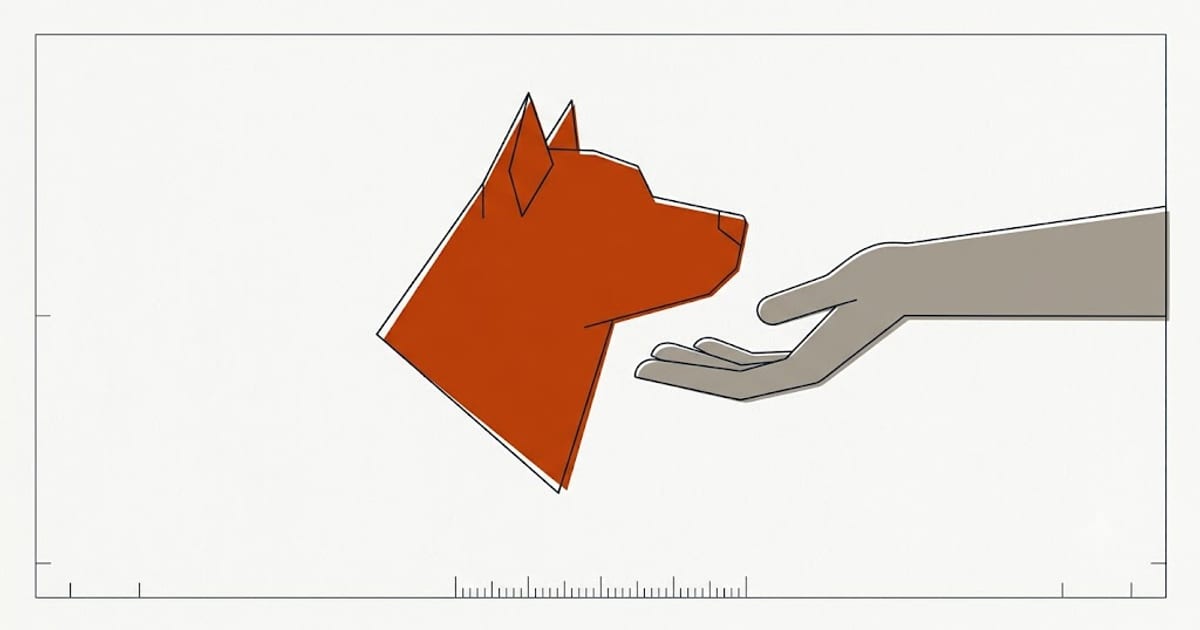
Licking is one of the earliest behaviours a dog has. Puppies are licked by their mother from birth, and they lick her muzzle to solicit food and attention. It stays in the repertoire for life and picks up several other functions along the way.
Greeting and social contact
The most familiar version. A dog that licks hands and faces on arrival, briefly and with a loose wagging body, is doing something that traces directly back to puppyhood. In social terms it is closer to a greeting than to a kiss, and it is generally accompanied by other relaxed signals — soft eyes, a loose tail, a wiggling body.
Some of it is also taste. Human skin carries salt, and after exercise it carries more, which is why feet and hands get more attention than anything else. That is not a deep behavioural mystery; it simply tastes interesting.
Appeasement
The version people miss. Licking is also a calming signal, used to defuse tension. A dog that licks while being told off, while a stranger leans over it, or while being held still, is often asking for space rather than expressing affection.
The distinguishing features are the other signals around it. Ears back, a lowered head, whale eye with the whites showing, a tucked tail, a still or stiff body — those alongside licking mean discomfort, and the useful response is to give the dog room rather than to lean in further.
This matters because appeasement licking is one of the earliest points at which a dog says it is uncomfortable, and dogs whose early signals are consistently ignored stop using them.
Attention seeking
Dogs repeat what works. If licking a leg reliably produces a look, a word, or a hand reaching down, it becomes a request rather than a reflex.
This is easy to identify: it happens when you are occupied rather than when you arrive, it stops when you engage, and it escalates if you initially ignore it and then give in — which is exactly the pattern that strengthens a behaviour.
The response is consistency rather than correction. Turn away without speaking, and give attention a few seconds after the licking stops rather than during it.
Compulsive licking
A small number of dogs lick people, surfaces or themselves in a way that is sustained, repetitive and difficult to interrupt. This is a different thing from the versions above, and the giveaway is that it does not respond to context — the dog does it when alone, when settled, and when nothing is happening.
Persistent licking of floors, walls or furniture in particular has been associated with gastrointestinal discomfort in a proportion of cases, so it is worth a vet appointment rather than a training plan as a first step.
Whether to allow it
There is no health reason to stop a healthy dog licking clean skin, though it is sensible to avoid it around the face, on broken skin, and with anyone immunocompromised.
If you would rather it stopped, redirect rather than punish. Give the dog something to do with its mouth, reward calm greetings that do not involve licking, and be consistent — a behaviour that is discouraged nine times and permitted once becomes more persistent, not less.
Why the appeasement version is worth learning to see
Dogs signal discomfort along a fairly predictable sequence, and licking sits near the beginning of it — before turning away, before stiffening, before growling. Each of those is a request for space, and each is easier to respond to than the one after it.
The practical consequence is not about the dog's feelings. It is that a dog whose early signals reliably achieve nothing learns to skip them. That is the mechanism behind a great many reports of dogs that "bit without warning": the warnings were given for months in a form nobody was reading.
Nothing complicated is required. If a dog licks while a child leans over it, move the child. If it licks while being held for grooming, give it a break. The signal keeps working precisely because responding to it costs so little.
Licking that changes suddenly
A dog that has never been a licker and becomes one, or one whose licking becomes frantic rather than casual, is worth noticing. Sudden changes in any habitual behaviour are more informative than the behaviour itself, and licking in particular is associated with nausea in a proportion of cases.
Combined with lip licking, repeated swallowing, drooling, or eating grass, it belongs with a vet rather than with a training plan.